How to Sew a Drawstring Bag Step by Step
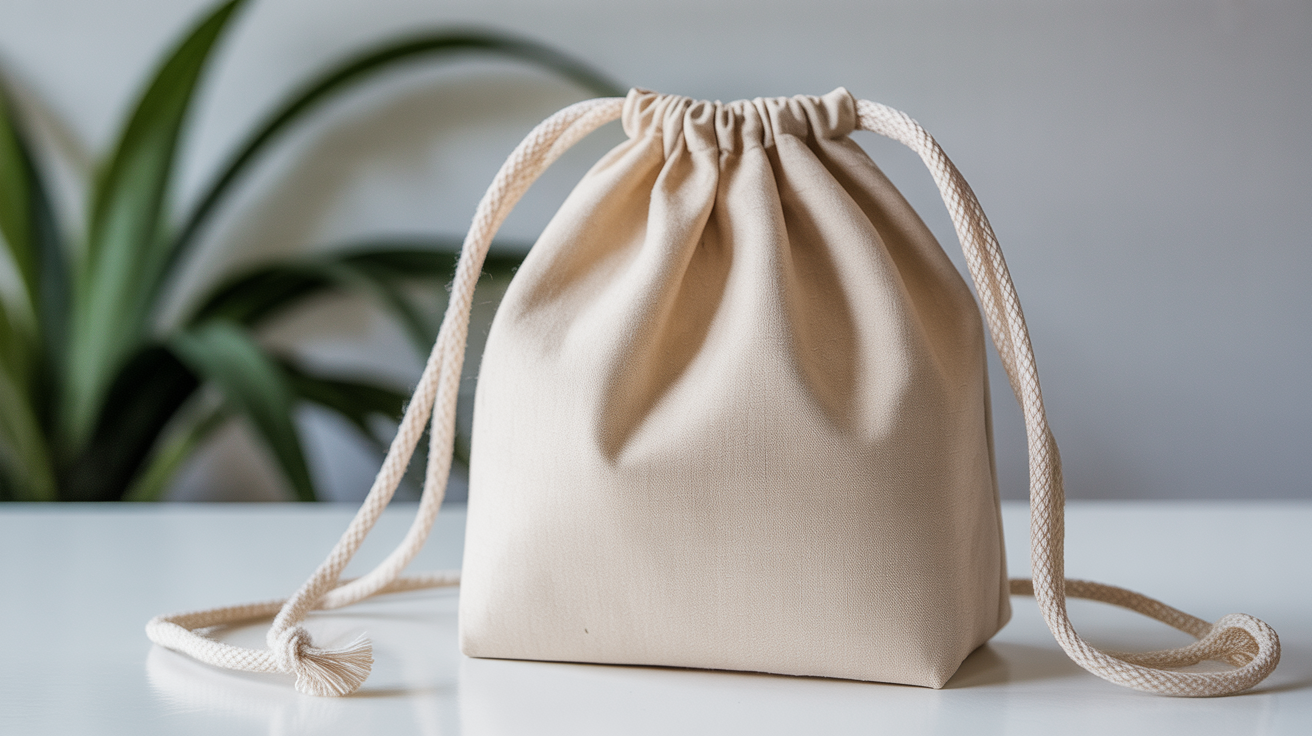
A drawstring bag is one of the most satisfying first projects you can sew. It is small enough to finish in a single sitting, it uses a flat piece of fabric with straight seams, and when you pull that drawstring tight for the first time, you get an immediate sense of "I made a real thing." This guide walks you through the whole process, from cutting your fabric to threading the cord, with no prior experience assumed.
If you are looking for more beginner ideas after this, the post 10 easy sewing projects for absolute beginners has a good range to try next.
What you need before you start
Gather everything before you sit down at the machine. Stopping mid-project to hunt for scissors breaks your concentration.
Fabric: Quilting cotton or calico works perfectly. Both are affordable, widely available, and easy to handle. A fat quarter (18 x 22 inches / 46 x 56 cm) gives you enough for a small bag with a little left over. Avoid stretchy jersey for your first attempt because the edges curl and drift under the presser foot.
Other supplies:
- Sewing machine with a general-purpose presser foot
- Thread that roughly matches your fabric (bobbin and top)
- Rotary cutter or fabric scissors (keep them away from children and only cut fabric with them, never paper)
- Cutting mat and ruler, or tailor's chalk and a meter stick
- Pins or wonder clips
- Safety pin (for threading the cord)
- Cord or ribbon for the drawstring: paracord, cotton twine, or a 1/4-inch (6 mm) cotton ribbon all work
Finished size: The bag in this tutorial will measure roughly 10 inches wide by 13 inches tall (25 x 33 cm) once sewn. You can scale up or down by adjusting your cut size.
Cutting your fabric
Cut one rectangle of fabric measuring 21 inches wide by 14 inches tall (53 x 36 cm). This single piece folds in half to form the bag, which means you have one less seam to manage.
Fold the rectangle in half with the short edges together, right sides facing in. The folded piece should now measure about 10.5 x 14 inches (27 x 36 cm). Press the fold lightly with a warm iron so the fabric lies flat.
Before you cut anything sharp or plug in the iron, make sure your workspace is clear and stable. Rest the iron on its heel when not in use and let it cool fully before storing.
Sewing the main seams
With the fabric still folded and right sides together, you are going to sew down both long sides, leaving a channel at the top for the drawstring.
Mark the channel gap first. From the top open edge, measure down 1.5 inches (4 cm) on each side and mark with a pin or chalk. This is where you will stop sewing. The gap you leave above the pin becomes the casing through which the cord travels.
Sew the side seams:
- Set your machine to a straight stitch, length 2.5.
- Starting at the top of one side at your 1.5-inch mark, sew down to the bottom fold, using a 3/8-inch (1 cm) seam allowance. Backstitch a few stitches at the start and end.
- Repeat on the other side.
The bottom is already closed because it is a fold, so you now have a simple tube open at the top.
If you want the bag to stand up on its own with a flat base, see the section on boxing corners below. Otherwise, skip ahead to the drawstring channel.
Boxing corners (optional but useful)
Boxing corners adds a few inches of depth to the bottom of the bag, which is handy for gym kits, library books, or anything bulkier than a snack.
Turn the bag inside out so you can see the seams. At each bottom corner, pinch the corner so the side seam sits directly on top of the fold line, forming a triangle point. Measure 1.5 inches (4 cm) from the point along the triangle and draw a line perpendicular to the seam. Sew along that line. Trim the triangle away, leaving a 3/8-inch (1 cm) seam allowance. Repeat on the other corner.
When you turn the bag right side out, the base will be flat.
Making the drawstring channel
The channel is just a folded hem at the top of the bag. It needs to be wide enough for your cord to pass through easily.
Turn the top raw edge down 1/4 inch (6 mm) and press. Fold it down again by 1.25 inches (3 cm) and press again. Pin or clip it in place. This creates a neat double fold with no raw edges showing inside the channel.
Now sew two parallel rows of stitching to close the channel:
- One row close to the bottom folded edge of the channel (about 1/8 inch / 3 mm from the edge).
- One row about 1/4 inch (6 mm) above the first, near the top.
The two rows create the tunnel the cord will sit inside. Make sure you leave the side gaps you marked earlier open, because that is where the cord enters and exits. Do not sew across those openings.
Turn the bag right side out through the top opening and give it a good press.
Threading the drawstring cord
Cut two lengths of cord, each about 30 inches (76 cm) long. You will thread one cord through the entire channel from the left side opening, all the way around, and back out the left side. The second cord does the same from the right side. When you pull both cords together, the bag cinches evenly.
Here is the easiest way to do it without losing the cord inside the channel:
- Attach a safety pin to one end of the cord. The safety pin acts as a guide you can grip through the fabric.
- Insert the pinned end into the left side opening.
- Work the safety pin around through the channel, bunching the fabric up as you go, until it reappears at the left side opening.
- Knot both ends of that cord together so it cannot pull through.
- Thread the second cord starting from the right side opening, going all the way around, and knotting those ends.
When you hold both knotted ends in one hand and pull, the bag closes. To open it, pull the bag apart by its two sides.
Finishing touches
A few small details make the difference between a project that looks rushed and one you are proud to give as a gift.
| Step | What it does | Worth doing? |
|---|---|---|
| Zigzag or serge the raw seam allowances inside | Stops the edges from fraying over time | Yes, highly recommended |
| Press the finished bag | Flattens seams, sharpens the channel folds | Yes, takes 2 minutes |
| Trim threads | Removes the loose ends that catch on things | Always |
| Topstitch along the side seams | Gives a crisp, store-bought look | Optional but nice |
If your machine has a zigzag stitch, run it along the inside seam allowances before you turn the bag right side out. Set the stitch width to about 3 and the length to 2.5, and sew close to the raw edge. This one step adds years to the bag's life.
For a tote bag that uses similar straight-seam construction on a larger scale, the tutorial how to sew a simple tote bag for beginners is a natural next step once you have this drawstring version done.
Frequently asked questions
What fabric is best for a drawstring bag?
Quilting cotton and calico are the easiest choices for beginners. They are stable, do not fray excessively, and press well with an iron. Once you are comfortable, you can try canvas for a sturdier bag, or cotton muslin for a lighter one. Avoid slippery fabrics like polyester satin until you have a few more projects under your belt.
How long should the drawstring cord be?
For a bag around 10 inches (25 cm) wide, cut each cord 28 to 32 inches (71 to 81 cm) long. The cord needs to travel all the way around the inside of the channel plus leave enough tail on both ends to grip and knot. If in doubt, cut longer and trim after you thread it.
My cord is bunching up inside the channel and won't move. What do I do?
The channel is probably too narrow for your cord. Check that you pressed the folds flat before stitching, and that you sewed far enough from the lower fold edge to leave a proper tunnel. If the bag is already finished, you can also try a thinner cord. Paracord inner strands or thin ribbon often fit through tighter channels when the original cord does not.
Can I make this bag without a sewing machine?
Yes, with patience. Use a running stitch or backstitch with a strong thread. A backstitch is much stronger and holds up better to daily use. Plan for the hand-sewn version to take two to three times longer, and use a shorter stitch length than you might think you need.
How do I adjust the size?
The formula is simple. For the cut size, take your desired finished width, multiply by two (because the fabric folds in half), and add 1 inch (2.5 cm) for seam allowances. For the height, add 3 inches (7.5 cm) to your desired finished height to allow for the drawstring channel at the top and the seam at the bottom. Scale the cord length up accordingly.