How to Sew On a Button by Hand (4-Hole and Shank)
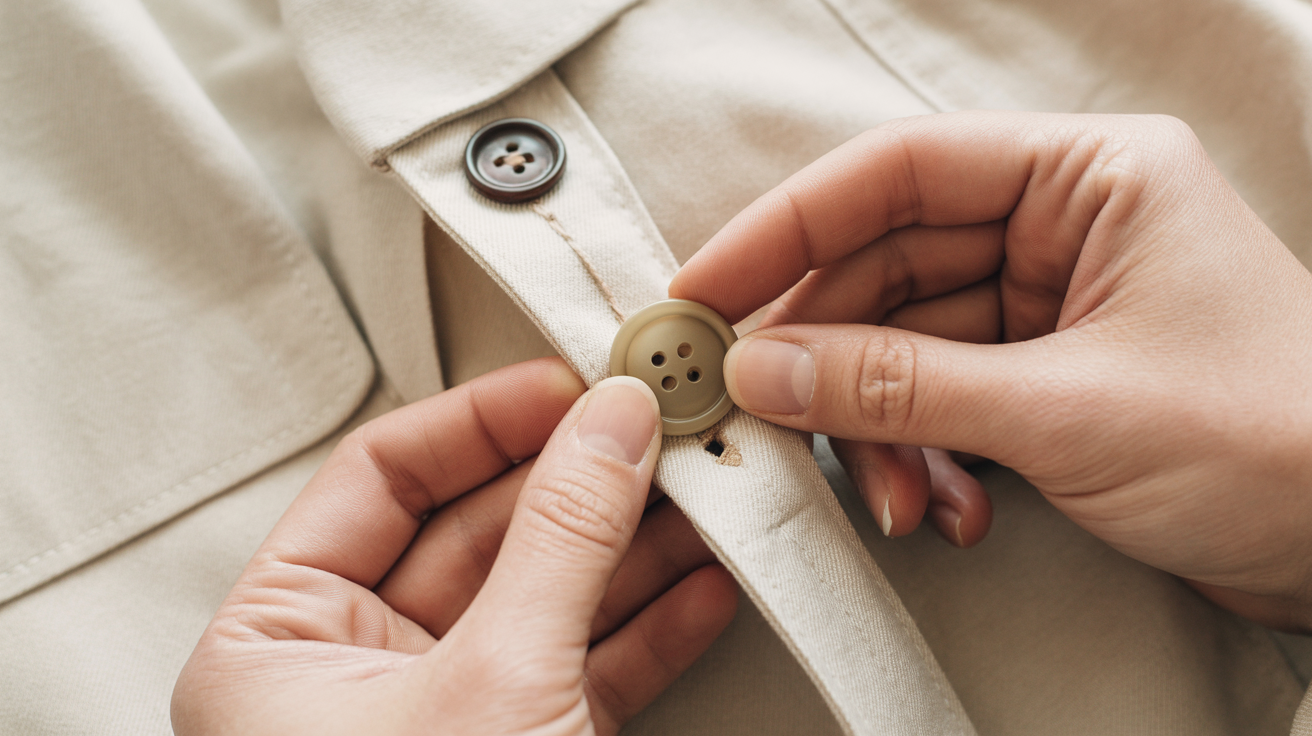
A button falls off. You find it on the floor, or worse, in the dryer. It happens to everyone, and the good news is that sewing it back on takes about five minutes once you know what you're doing. No machine needed, no special skills, just a needle, some thread, and this guide.
This article covers the two button types you're most likely to encounter: the 4-hole button (flat, with four holes punched through it) and the shank button (which has a little loop on the back instead of holes). The process is slightly different for each, and both are straightforward once you've done it once.
What you need before you start
Gather everything before you sit down. Hunting for scissors mid-stitch gets old fast.
- A hand-sewing needle (a size 7 or 8 sharps needle works for most fabrics and thread)
- Thread that matches the other buttons on the garment, or as close as you can get
- Small scissors or a thread snip
- The button itself
- Optional but helpful: a toothpick or a straight pin (explained below)
Thread choice matters more than people think. For shirts and blouses in quilting cotton or poplin, standard all-purpose polyester thread is fine. For heavier fabrics like denim, canvas, or wool coating, use a heavier thread such as upholstery thread or button-and-craft thread. Doubling a standard thread (threading it through the needle so you have two strands) is a common and perfectly acceptable trick for extra strength.
Cut about 18 inches (45 cm) of thread. Much longer than that and it will knot on itself constantly. If you need more later, you can always start a second length.
Before you pick up that needle, double-check the fabric around the button site. If the original stitching left a hole or the fabric is fraying, reinforce the area with a small scrap of iron-on interfacing on the wrong side before you begin. Takes two minutes and prevents the whole thing from tearing through again.
For threading the needle and tying a knot that will actually hold, see our guide on how to thread a needle and tie a knot that holds before you continue.
How to sew on a 4-hole button
A 4-hole button has, predictably, four holes arranged in a square. You stitch through pairs of holes to anchor it. There are a few common stitch patterns: parallel lines (through holes 1+3 and then 2+4), an X pattern, or a square. Look at the other buttons on the garment and match the pattern. If there are no others to reference, parallel lines are the standard choice for most clothing.
The thread shank: why it matters and how to make one
This is the part most beginners skip, and it's the reason buttons fall off or pull fabric oddly. When you button a garment, the fabric on both sides has a little thickness between them. If your button is stitched flat against the surface with no give, every time you close the button it tugs hard on those stitches. A thread shank is a tiny column of thread under the button that creates space for the buttonhole layer to rest without straining anything.
To make one, lay a toothpick or a straight pin across the top of the button before you start stitching. Sew your stitches over the pin. When you're done with the through-stitches, pull the pin out, lift the button away from the fabric slightly, and wind the remaining thread around the stitches under the button five or six times. This wrapping becomes the shank. Then bring the needle through to the back and knot off.
Step-by-step for a 4-hole button
- Push the needle up from the wrong side of the fabric, coming up through the spot where the button will sit. Pull the thread through until the knot catches on the back.
- Place the button on the fabric with the toothpick or pin lying across it.
- Push the needle down through the first hole (say, top-left) and back up through the diagonal or parallel hole (bottom-left for parallel lines, bottom-right for an X). The needle goes: up through fabric and hole, down through adjacent hole and fabric.
- Repeat that pass 4 to 6 times for each pair of holes. The stitches should be snug but not distorting the fabric underneath.
- Repeat for the second pair of holes.
- Remove the toothpick. Lift the button so the stitching underneath becomes a loose column. Wind the thread around that column 5 or 6 times, fairly tightly.
- Push the needle through to the wrong side and take two or three small stitches into the fabric, looping through the last stitch each time to lock it. Trim the thread close.
Total passes through each hole pair: 4 to 6. Total time: 3 to 5 minutes once you're comfortable.
How to sew on a shank button
A shank button has no holes through the face. Instead, there's a solid loop, usually plastic or metal, protruding from the back. That loop is the shank, so you don't need to make a thread one. The loop itself provides the clearance between button and fabric.
Step-by-step for a shank button
- Push the needle up from the wrong side at the button placement mark. Pull through until the knot catches.
- Slide the needle through the shank loop (from front to back, or side to side, it doesn't matter as long as you're consistent).
- Push the needle back down through the fabric right next to where it came up, within about 1/8 inch (3 mm).
- Bring the needle up again and through the shank again. Repeat this 6 to 8 times. The stitches pile up inside the shank loop.
- Finish by bringing the needle to the wrong side, taking two or three small locking stitches, and trimming the thread.
Because the shank is already doing the spacing work, you're simply building up strong stitches through it. The more passes you take, the more secure the attachment.
Finishing on the wrong side
The back of the fabric should look tidy and feel flat against your skin. A messy or bulky back is uncomfortable and suggests the stitches aren't locked properly.
After your final passes, take two small stitches directly into the fabric (not through a previous stitch, but into the fabric weave itself) and then on the third stitch, before pulling completely tight, pass the needle through the loop you've just created. This is a basic lock stitch. Do it twice and you don't need to knot in the traditional sense, though a simple overhand knot is also perfectly fine. Trim to about 1/4 inch (6 mm). No need to trim flush, a small tail won't cause any problems.
If your thread end frays, a tiny dab of fray-check liquid or even clear nail polish will seal it. Let it dry before wearing.
Common mistakes and how to fix them
Even experienced sewers occasionally redo a button. Here are the problems that come up most often.
| Problem | Likely cause | Fix |
|---|---|---|
| Button sits crooked or tilted | Stitches uneven across hole pairs | Remove and restitch, taking equal passes through each hole pair |
| Button pulls fabric into a pucker | No thread shank, or stitches pulled too tight | Remove and restitch with a toothpick spacer to build a shank |
| Thread shows on the right side of fabric | Started knot is too small and slipped through | Use a larger knot, or take an anchoring stitch on the wrong side first |
| Button feels loose after only a few wears | Too few passes through the holes | Aim for at least 4 to 6 passes per hole pair; heavy fabrics need more |
| Thread keeps tangling mid-stitch | Thread too long | Work with 18 inches (45 cm) max; cut a fresh piece if needed |
The most common problem by far is skipping the thread shank. It's easy to forget and easy to underestimate. If a button keeps coming off the same spot repeatedly, it's almost always because the stitching was flat with no shank, and the buttonhole fabric has been slowly working the threads loose every time you do up the garment.
Matching thread and button to the garment
Replacement buttons can be tricky. A few practical tips:
- Take one of the original buttons (from a spare in the lining hem, or a less visible spot like a cuff) to the fabric or notion store. Comparing in person beats guessing from a photo.
- Buttons are sized in lignes (pronounced "lines"), an old French unit. 24 ligne = roughly 15 mm = about 5/8 inch. Most shirt buttons are 16 to 20 ligne. Most coat buttons are 30 to 40 ligne.
- If you can't find an exact match, consider replacing all the visible buttons at once in a complementary style rather than trying to match one odd one.
Thread color: hold a few strands of thread against the button and the fabric. The thread should blend with the button, not the fabric, since the thread stitches will be visible on the button face. That said, on heavy coats where the shank is large and thread shows on the fabric too, matching the fabric color is smarter.
For more techniques to build your hand-sewing confidence, take a look at basic hand sewing stitches every beginner should learn. Knowing a few foundational stitches makes every hand-repair job easier, including this one.
Frequently asked questions
How many times should I stitch through a button hole?
For a standard shirt button on medium-weight fabric like cotton or linen, 4 to 6 passes per pair of holes is enough. For heavier fabrics (denim, canvas, outerwear wool), do 6 to 8 passes and consider using doubled thread or heavier button-and-craft thread. The button should feel firmly planted with no wobble when you tug it lightly.
Can I use regular sewing thread or do I need special button thread?
Regular all-purpose polyester thread works for most garments. You can double it through the needle for extra strength, which gives you two strands working together. Button-and-craft thread (sometimes called upholstery thread) is thicker and stronger, and worth using for coats, heavy jackets, or any button that takes real stress. For delicate fabrics like silk or fine wool, use a finer thread so it doesn't distort the weave.
What if I don't have a replacement button?
Check the inside seam hems of the garment first. Many manufacturers sew a spare button inside the hem of shirts and jackets. Failing that, rob a button from a less visible spot (inside a cuff, bottom of a placket) and replace that spot with a close match. You can also order single buttons from online notions shops, or visit a fabric store with a button section. Vintage buttons from thrift shop garments are another good source.
My button keeps popping off even after I resew it. What am I doing wrong?
The most likely explanation is that the thread shank is missing or too short, so the buttonhole fabric is yanking the stitches every time you fasten it. The second most common cause is too few passes through the holes, especially on a garment that sees a lot of wear. Try this: remove the button completely, cut away all old thread, and restitch with at least 6 passes per hole pair, a proper thread shank (5 to 6 wraps under the button), and locked finishing stitches on the back. Also check the fabric behind the button site for thinning or fraying, since worn fabric won't hold stitches no matter how carefully you sew. A small square of iron-on interfacing on the wrong side, trimmed to about 1 inch (2.5 cm) square, can give frail fabric enough body to hold.
Does the pattern I use to stitch a 4-hole button actually matter?
It matters mostly for appearance and, to a lesser degree, stability. The X pattern distributes stress evenly in all directions, which is good for buttons that open and close frequently. Parallel lines are the most common on ready-to-wear clothing and look neat and intentional. A square pattern (stitching around the perimeter of the four holes) is decorative and appears on some tailored garments. Functionally, any of the three holds the button well if you've made enough passes and finished the stitches securely. For a button you're replacing, match whatever pattern the other buttons on the garment use.