Basic Hand Sewing Stitches Every Beginner Should Learn
Hand sewing is one of those skills that feels intimidating until you actually do it. Once you understand a handful of stitches, you can mend a torn hem, tack down a wayward button, and even piece together simple projects without ever touching a machine. This guide walks you through the stitches worth learning first, what each one does, and when you'd reach for it.
Before you start, get your needle threaded and your knot tied. If that step still trips you up, the guide on how to thread a needle and tie a knot that holds will sort you out. Use a sharp needle (a size 7 or 8 "sharps" needle suits most hand-sewing tasks), a length of thread no longer than about 18 inches (45 cm), and a scrap of quilting cotton or calico to practice on.
At a Glance
- Learn four stitches in this order: running stitch first, then backstitch, whip stitch, and slip stitch.
- The running stitch is fast and simple but weak; it's for basting, gathering, and quilting, not for seams under stress.
- The backstitch is the strongest hand stitch and the one to reach for on any repair or seam that needs to hold.
- The whip stitch joins two edges quickly; the slip stitch hides its stitches inside a fold for an invisible finish.
- Keep thread to about 18 inches (45 cm) and stitches around 1/8 to 1/4 inch (3 to 6 mm) for most general sewing.
- A secure finish (a small looped knot on the back) outlasts a plain overhand knot, especially through repeated washing.
What you need before you pick up a needle
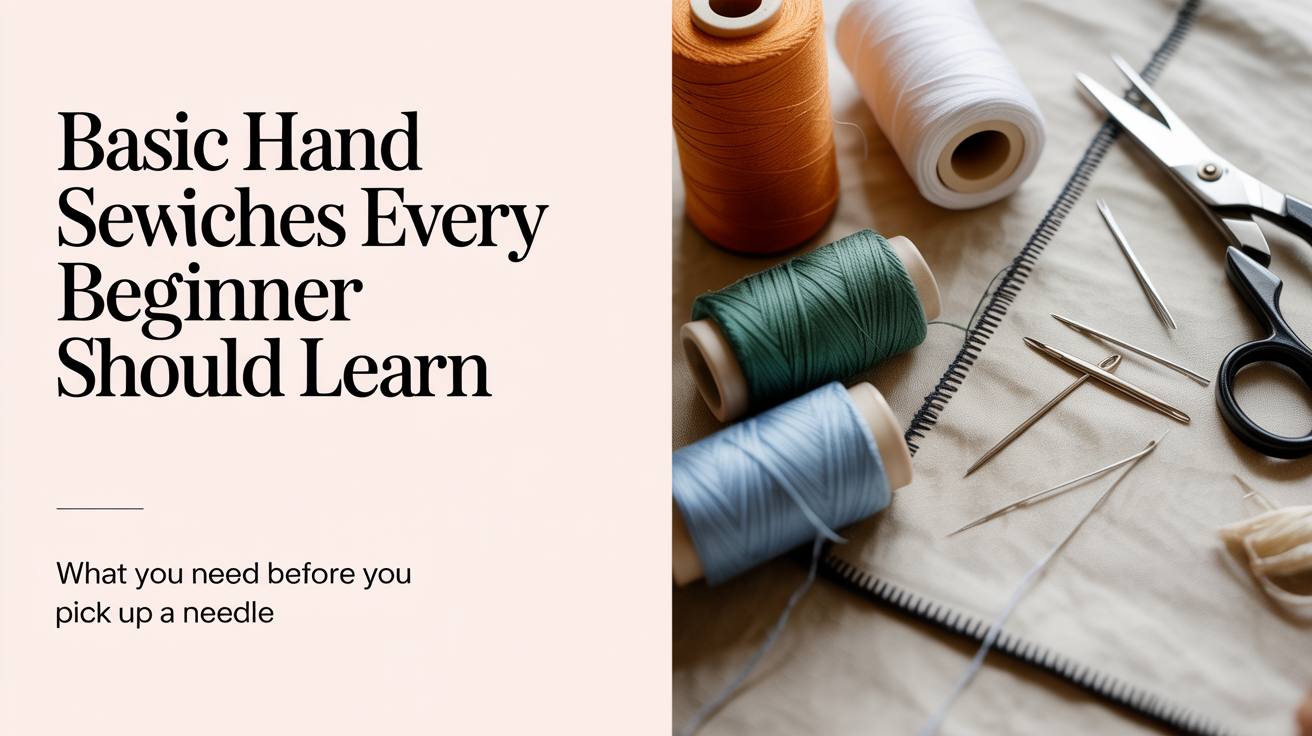
Good hand sewing relies on simple tools used carefully. Needles are sharp, pins scatter, and scissors can cause real harm if left where children or pets can reach them. Keep a small pincushion nearby so loose needles always have a home.
Here's what a beginner's hand-sewing kit should include:
- Sharps needles, sizes 7-9. These are the all-purpose workhorses. Smaller numbers mean thicker needles; start with an 8 for medium-weight fabrics.
- All-purpose polyester thread. A neutral color (white, grey, or beige) gets you through most practice sessions. Match the thread to your fabric for real projects.
- Small, sharp scissors. Embroidery scissors or thread snips with pointed blades let you clip close to the fabric without slipping.
- Thimble. Optional but worth trying. Pushing a needle through multiple layers is tiring on your fingertip.
- Scrap fabric. Quilting cotton or calico is ideal for learning because it doesn't stretch or fray too aggressively. Practice on this before touching your actual project.
Cut your thread at an angle before threading the needle; it makes a crisper point that slips through the eye more easily. Pull about 6 inches (15 cm) of thread through so the short tail doesn't slip out mid-stitch.
The running stitch: your starting point
The running stitch is the simplest stitch in hand sewing, and it turns up everywhere: basting fabric before a machine stitch, gathering fabric into ruffles, quilting layers together, and decorative embroidery. According to Wikipedia's overview of the stitch, it's the foundation nearly every other hand stitch builds on, since most variations are just changes in the length, spacing, or direction of this same in-and-out motion. If you only practice one thing today, make it this one.
To sew a running stitch:
- Push the needle up through the fabric from the back (wrong side) to the front.
- Push it back down through the fabric about 1/4 inch (6 mm) along.
- Bring it back up another 1/4 inch ahead.
- Repeat, loading 3 or 4 stitches onto the needle at once before pulling the thread through.
The result is a dashed line of stitches with equal gaps between them. Aim for consistent stitch length; the gaps and the stitches should be roughly the same size. Uneven stitching looks messy and can create weak points in a seam.
The running stitch is not strong on its own. It's better suited to temporary work (like basting) or decorative details than to seams that need to hold under tension. For a full breakdown of when to use it and how to keep your rows straight, see how to sew a running stitch and when to use it.
Gathering with a running stitch
To gather fabric, sew two parallel rows of running stitches about 1/8 inch (3 mm) apart within your seam allowance. Leave long thread tails at each end. Hold both tails on one side and gently slide the fabric along the threads toward the center. The fabric will pucker into even gathers. This is how you add fullness to a skirt waistband or a sleeve cap. As a working estimate, gathering a 20-inch waistband down to a 14-inch band takes about 6 inches of ease per row, spread across roughly 80 stitches at 1/4 inch each.
The backstitch: the strongest hand stitch
If the running stitch is a dash, the backstitch is a solid line. It makes a nearly continuous seam that can hold real stress, which is why it's the hand-sewing equivalent of a machine straight stitch. Wikipedia notes that the small, overlapping stitches worked back-and-forth make the backstitch the strongest of the basic hand stitches, strong enough to attach two pieces of fabric permanently without a machine at all. Use it any time you need a seam to stay put: closing the gap on a stuffed toy, repairing a split seam in a garment, or sewing a small piece where a machine would be awkward.
The motion goes backward before it goes forward, which is what makes it so secure.
- Bring the needle up through the fabric.
- Push it back down one stitch length behind where it came up (going backward).
- Bring it up one stitch length ahead of where it first came up.
- Push it back down again to where the thread exited in the previous stitch.
On the front you see a solid line. On the back you see overlapping stitches, roughly double the thread density of a running stitch over the same distance, which is exactly why it holds so much better. Aim for stitches about 1/8 to 1/4 inch (3 to 6 mm) long for general seaming.
The backstitch guide goes into much more depth, including how to start and finish the stitch securely and how to keep your line from wobbling.
A common beginner mistake is making the backward stitch too short, which leaves gaps in the line on the front. If you can see daylight between your stitches, extend each backward stitch until it meets the previous one cleanly. A second common mistake is pulling the thread too tight after every stitch, which draws the fabric into a slight ripple; snug is enough, and the seam should still lie flat when you smooth it with your fingers.
The whip stitch: joining edges and closing seams
The whip stitch wraps thread over two edges to join them together. It's fast, and it doesn't require you to align the fabric precisely before you start, which makes it useful for joining the edges of felt pieces, closing the opening on a sewn-stuffed item (after you've turned it right-side out), or attaching applique shapes to a background fabric.
- Hold two fabric edges together, wrong sides facing each other.
- Bring the needle up through both layers at one end.
- Pass the thread over the top of the joined edges and push the needle up through both layers again, about 1/4 inch (6 mm) along.
- Repeat, always working in the same direction.
The resulting stitches angle diagonally across the edge. Keep your tension even; pull each stitch snug but not so tight that the fabric puckers. For a nearly invisible finish on felt or lightweight woven fabric, match the thread color exactly and keep the stitches small (1/8 inch or 3 mm).
If you're closing the opening on a stuffed cushion or soft toy, fold the seam allowances in first so the raw edges are hidden inside, then whip stitch along the fold. The seam will look almost as neat as a machine-finished edge. On a typical 4-inch (10 cm) stuffing gap, expect to sew somewhere around 15 to 20 whip stitches to close it securely.
The slip stitch: the invisible finish
The slip stitch (sometimes called the ladder stitch or blind stitch when used to close seams) is how you join two folded edges without leaving any visible stitching on the outside. It's the stitch for hemming trousers, closing pillowcase openings, and finishing linings. Wikipedia's entry on the technique describes it as a way to close a seam invisibly from the outside of the garment, which is exactly why it's the standard choice for finishing stuffed items and linings where the back side isn't accessible.
The secret is that each stitch hides inside a folded edge, emerging to cross to the opposite fold before diving back in.
- Fold both edges inward so the raw fabric is hidden.
- Knot your thread and hide the knot inside one fold by inserting the needle into the fold and bringing it out at the edge.
- Take a tiny stitch (1/8 inch or 3 mm) directly across into the opposite fold.
- Travel 1/4 inch (6 mm) inside that fold, then emerge at the edge again.
- Cross back to the first fold and repeat.
When you pull the thread through, the stitches tighten and the two folds draw together neatly. Beginners often pull too hard and create a puckered line; a light, consistent tension is what you want.
This stitch requires more patience than the backstitch or running stitch. Practice the hand motion on two strips of calico before attempting it on a visible hem. A pair of pants hemmed with a slip stitch usually takes 60 to 90 seconds per inch of hem once you're comfortable with the motion, so budget 10 to 15 minutes for a full pant leg.
Comparing the stitches: a quick reference
This table sums up when each stitch is most useful and how strong it is. Use it when you're staring at a project and can't quite remember which stitch to reach for.
| Stitch | Strength | Typical stitch length | Best uses | Stitches visible? |
|---|---|---|---|---|
| Running stitch | Low | 1/4 in (6 mm) | Basting, gathering, quilting, decoration | Yes (dashed line) |
| Backstitch | High | 1/8-1/4 in (3-6 mm) | Seaming, repairs, anywhere that needs to hold | Yes (solid line) on front |
| Whip stitch | Medium | 1/8-1/4 in (3-6 mm) | Joining edges, closing stuffed items, applique | Yes (diagonal wraps) |
| Slip stitch | Medium | 1/8 in (3 mm) | Hemming, closing linings, invisible seams | Barely (hidden in folds) |
How much thread and time each stitch takes
A rough worked example, based on a 6-inch (15 cm) seam or hem:
| Stitch | Stitches needed | Thread used | Time (once practiced) |
|---|---|---|---|
| Running stitch | ~24 | ~10 in (25 cm) | 1-2 minutes |
| Backstitch | ~24-36 | ~16 in (40 cm) | 3-4 minutes |
| Whip stitch | ~24 | ~12 in (30 cm) | 2-3 minutes |
| Slip stitch | ~24 | ~14 in (35 cm) | 4-6 minutes |
The backstitch and slip stitch use more thread than the running or whip stitch because each one doubles back or travels inside the fold, not because the stitches are longer.
How to start and end every stitch cleanly
A stitch is only as secure as its beginning and end. Loose starts unravel; poor knots pop at the worst moment.
To start, make a small knot at one end of your thread. For hand sewing on most woven fabrics, a simple overhand knot works. Pull the thread tail until the knot sits snugly against the fabric's back surface, or bury it inside a seam allowance so it doesn't show through to the front.
To finish, bring the needle to the back of the work. Take two or three tiny stitches in place (in the same spot) and pass the needle through the resulting loop before pulling tight. This creates a small, flat knot that sits against the fabric rather than a large lump. Clip the thread close, leaving about 1/8 inch (3 mm).
A common shortcut is just tying an overhand knot to finish. It works, but the knot can loosen over time, especially on fabrics that get washed repeatedly. The looped finish is more reliable for anything you want to last.
Frequently asked questions
What is the best stitch for an absolute beginner to learn first?
Start with the running stitch. It has one simple motion, it's forgiving of uneven tension, and it teaches you the basic in-and-out rhythm of hand sewing. Once it feels natural, move to the backstitch, which gives you real seaming strength.
How do I keep my stitches straight without a guide?
Use a ruler and a fabric pen or tailor's chalk to draw a light line before you start. On quilting cotton or calico, a crease from your fingernail pressed along a fold also works well as a guide. Checking the back of your work periodically helps you catch a wandering line before it goes too far.
How long should my thread be when hand sewing?
Keep it to about 18 inches (45 cm) at most. Longer threads tangle, knot on themselves, and fray from being pulled through the fabric so many times. If you need more thread, finish off cleanly and start a new length.
Is hand sewing as strong as machine sewing?
A well-sewn backstitch comes close to a machine straight stitch for strength, but it takes longer and is less consistent. Machine sewing is generally faster and more uniform for long seams. Hand sewing is better for details, repairs, and situations where a machine is too bulky to reach.
What thread should I use for hand sewing?
All-purpose polyester thread works for most hand-sewing tasks: repairs, closures, and basic seaming. For embroidery or decorative work, use stranded embroidery floss (you can separate the strands to use 2 or 3 at a time for finer work). Avoid using machine embroidery thread for hand sewing; it's finer than you need and can fray quickly.
My stitches look fine at first but come loose after a few wears. What's going wrong?
Almost always this comes down to the finishing knot, not the stitch itself. A single overhand knot at the end can work its way loose through repeated stretching and washing. Switch to the looped finish described above, and on high-stress spots like a button or a stuffed-toy seam, take an extra backstitch or two right at the point of strain before you tie off.
Can I mix stitches within the same seam or repair?
Yes, and it's often the smart choice. A common combination is a backstitch across the strained part of a repair (like the center of a split seam) and a running stitch or slip stitch along the calmer edges, where full strength isn't needed. Matching the stitch to what each section of the seam actually has to withstand saves time without sacrificing durability where it counts.