How to Thread a Needle and Tie a Knot That Holds
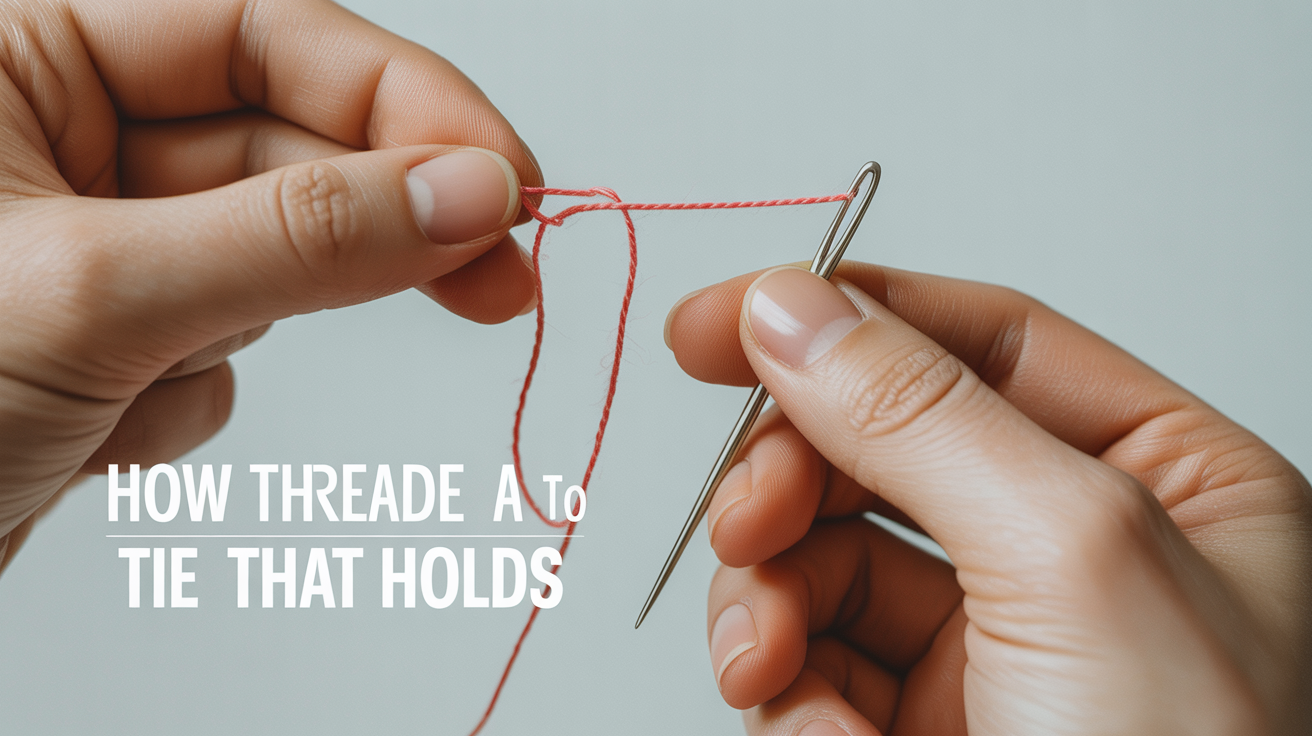
Threading a needle sounds so simple that you might feel embarrassed asking about it. Don't. Every experienced sewer has stabbed a thread at the eye of a needle a dozen times before it went through, and almost everyone ties a knot that falls out at least once before learning the trick that makes it hold. This guide walks you through both steps slowly and clearly, so you can pick up any needle and get stitching with confidence.
At a Glance
- Cut thread to about 18 inches (45 cm); longer lengths tangle and weaken as you pull them through fabric repeatedly.
- Bring the needle's eye down onto the thread rather than pushing the thread up at the needle for more control.
- A needle threader is a legitimate tool, not a shortcut for beginners only. Many experienced sewers use one every time.
- Tie the wrapped quilter's knot (two or three wraps around the needle, pulled snug) rather than a loose overhand knot for a smaller, more secure anchor.
- Always knot the long cut end of the thread, never the short end nearest the needle.
- Finish a line of stitching with a loop-and-pass knot on the wrong side rather than just cutting the thread.
What you need before you start
Gather these before sitting down:
- A hand-sewing needle in size 7 or 8 (sharp, not embroidery or tapestry)
- Thread in a color you can see clearly against a light background, at least to start
- Small scissors or a thread cutter
- Good light, ideally natural or a bright lamp aimed at your hands
- Optionally, a needle threader if your eyes or hands need a little help
Thread length matters. Cut a piece about 18 inches (45 cm) long. Anything longer tends to tangle and knot on itself while you work. If you are doing a long project, you will re-thread more often rather than fight a 36-inch tail.
Sharp scissors make a cleaner cut end, which threads far more easily than a frayed or squashed tip. If your thread end looks fluffy, snip it fresh.
Needle size follows a sizing convention where the number runs opposite to the size on the packet: as the number gets smaller, the needle gets thicker and longer. A size 7 sharps needle is noticeably shorter and finer than a size 5, and needle eye shape also varies by type: standard sharps have a small round eye, while embroidery needles carry a longer eye built for thicker threads and floss.
How to thread a needle by hand
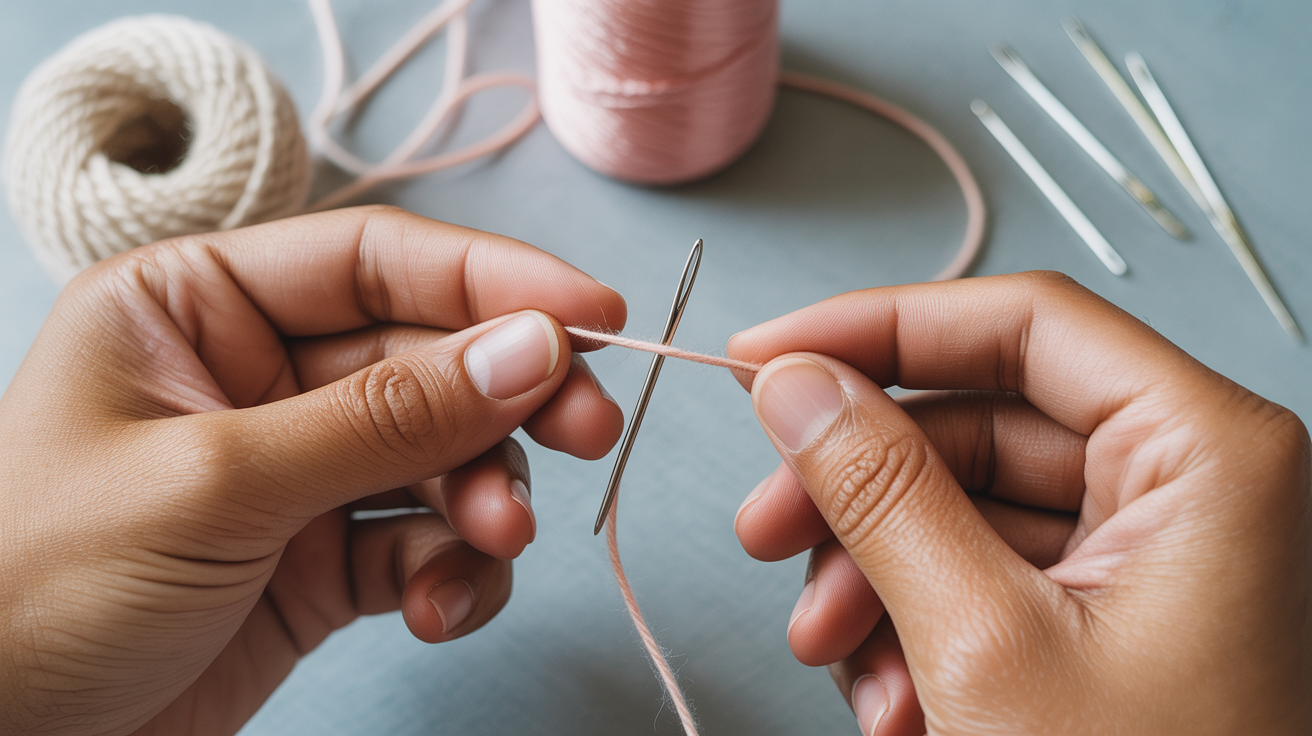
Hold the needle between the thumb and index finger of your non-dominant hand, with the eye (the hole at the top) facing you. Keep it as still as possible.
Now take the cut end of your thread in your dominant hand. Instead of poking the thread at the needle, try this:
- Pinch the thread very close to the tip, leaving only a tiny bit sticking out, maybe 1/8 inch (3 mm). The less thread you expose, the less it can wobble.
- Bring the eye of the needle down onto the thread rather than pushing the thread up at the needle. You control the needle more precisely.
- When the thread disappears through the eye, pull 4 to 6 inches (10 to 15 cm) through so you have a tail to work with.
If you have been trying for more than a minute with no luck, check these things:
- Is there enough light? Even slightly dim conditions make the eye look like a shadow.
- Is your thread end frayed? Snip it again cleanly.
- Are you trying to thread a doubled length through a small needle? Try a slightly larger needle or use a needle threader.
A needle threader is a small tool built around a fine diamond-shaped wire loop held in a small tinplate or plastic frame. Push the wire through the eye, slip the thread through the wire loop, then pull the wire back. The thread follows it. It is not cheating; it is a tool, and many experienced sewers use one every single time.
Single thread or double thread?
Threading a needle by hand gives you a choice: use the thread single, or fold it in half and use it doubled.
| Method | Best for | Thread end to knot |
|---|---|---|
| Single thread | Light fabrics, applique, delicate repairs | One tail |
| Double thread | Buttons, heavier repairs, anything that needs strength | Both tails together |
For most beginner hand sewing, single thread is easier to manage. You knot the long end (the tail that hangs loose after threading), not the short end near the needle. Leave the short end at about 3 inches (8 cm) so it does not slip back through while you work.
Needle size at a glance
Needle numbering trips up a lot of beginners because smaller numbers mean bigger needles. Use this as a quick reference when a pattern or project calls for a size you don't already own.
| Sharps size | Typical use | Eye size |
|---|---|---|
| 3 to 5 | Heavy fabric, upholstery, denim repairs | Large |
| 6 | General mending, medium-weight cotton | Medium-large |
| 7 to 8 | Everyday hand sewing, most beginner projects | Medium |
| 9 to 10 | Fine fabric, invisible stitches, silk | Small |
| 11 to 12 | Delicate applique, lightweight silk | Very small |
If you sew embroidery floss, pearl cotton, or anything thicker than standard all-purpose thread, reach for an embroidery or crewel needle instead of a sharps in the same number. The shaft thickness is similar, but the eye is noticeably longer, which keeps the thicker thread from fraying as you pull it through.
How to tie a knot for sewing that actually holds
This is where many beginners go wrong. A thin, neat knot at the end of the thread does two things: it stops the thread from pulling straight through the fabric on the first stitch, and it gives you a tidy, hidden anchor. Here is the method that works reliably.
The basic quilter's knot (also called a thread knot)
- Hold the needle in your dominant hand, pointing away from you.
- Lay the long tail of the thread across the tip of the needle, left to right.
- Wrap the thread around the needle two or three times, right over the tip.
- Pinch those wraps between your thumb and index finger so they can not unwind.
- While still pinching the wraps, slowly pull the needle all the way through your fingers, pulling the thread with it.
- The wraps will slide down the length of the thread and stop at the end, forming a small, firm knot.
That little knot should be about the size of a sesame seed. If it is much bigger, you wrapped too many times. If it slides off the end entirely, wrap once more and try again.
Why not just tie a regular overhand knot?
You can, and sometimes it is fine. But an overhand knot tends to leave a loose tail and can pull through weave gaps in lighter fabrics. The quilter's knot sits flat against the thread and is less likely to pop through. On thicker fabrics like denim or canvas, an overhand knot done twice (surgeon's knot style) works well.
If you are sewing on a button, the knot will sit on the inside of the garment. Make sure it is big enough not to pass through the fabric. On a loose-weave linen or a knit, you may need two wraps plus a second knot right on top of the first.
Starting and finishing your stitching
Once threaded and knotted, push the needle up from the wrong side (the inside or back of the fabric) so the knot lands against the fabric and hides. That way it is invisible on the right side.
When you finish a line of stitching, you need to secure the end so it does not unravel. Do not just cut the thread and hope for the best.
A simple finishing knot:
- On the wrong side of the fabric, take a tiny stitch, but do not pull it all the way through. Leave a small loop.
- Pass the needle through that loop once.
- Pull snug. Repeat once more for insurance.
- Trim the tail to about 1/4 inch (6 mm).
This gives a small, secure anchor that hides inside the seam. It is essentially the same idea as the starting knot, just worked into the fabric itself.
From here, you are ready to try actual stitches. The running stitch is the simplest place to start, and it uses exactly this threading and knotting method you just practiced. When you want something stronger, the backstitch uses the same setup but locks each stitch into the previous one.
Common problems and quick fixes
Even when you know the method, things go wrong. Here is what to look for:
- Thread keeps tangling: You are probably working with too long a piece. Cut down to 16 to 18 inches (40 to 45 cm).
- Knot pulls through on the first stitch: The knot is too small for that fabric's weave. Add another wrap, or tie a second knot directly over the first.
- Thread keeps slipping out of the needle eye: You pulled the short tail too far through, or the needle eye is too small for the thread weight. Match needle size to thread: heavier thread needs a needle with a larger eye.
- Thread is twisting and knotting mid-stitch: Let the needle hang freely now and then so the thread can untwist. It sounds odd but it works.
- Can't see the needle eye at all: Clip a fresh end, get better light, and try a size 7 needle instead of a smaller one. The eye on a size 5 or 6 is noticeably smaller than on a 7 or 8.
- Knot forms mid-thread instead of at the very end: You likely started wrapping too far from the tip of the needle, so the wraps had room to slide before catching. Reset, wrap right at the very point of the needle, and pinch firmly before pulling through.
- Needle keeps slipping out of your fingers while wrapping: Damp fingertips grip better than dry ones. A quick touch to slightly moistened fingers, or a rubber fingertip grip sold in most notions aisles, solves this for most people within a few tries.
Frequently asked questions
How long should my thread be when threading a needle?
Aim for 18 inches (45 cm) for most hand-sewing tasks. Longer thread is tempting because you re-thread less often, but it tangles, drags, and weakens as you pull it through fabric repeatedly. For basting or a long hem you can push toward 24 inches (60 cm), but that is about the practical limit.
Do I need a needle threader, or can I learn to do it without one?
You can absolutely learn to do it without one, and the technique above will get you there. That said, a needle threader is a legitimate tool, not a beginner crutch. Lots of sewers use one every time and there is nothing wrong with that. If you sew in low light, have unsteady hands, or the eye of your needle is simply tiny, a threader saves frustration.
Why does my knot keep coming undone when I sew?
Usually it means the knot is too small to grip the fabric weave, or you tied an overhand knot with too short a tail and it worked itself loose. Try the wrapped quilter's knot method described above, add an extra wrap, and make sure you are pulling the needle all the way through before releasing the pinch.
Should the knot go on the cut end or the needle end of the thread?
Always knot the cut end, which is the long tail hanging free. The short end near the needle eye should stay around 3 inches (8 cm) long to keep it from slipping back out, but that end does not get knotted. The knot anchors the thread on the far side of the fabric.
What size needle should a beginner use?
A size 7 or 8 sharps needle is a good starting point for most fabric and everyday thread. The eye is big enough to thread without too much trouble, and the needle is thin enough to pass through woven fabric cleanly. If you are using embroidery floss or pearl cotton, look for an embroidery needle with a longer, wider eye. For basic hand sewing stitches, a size 7 sharps will handle almost everything you try first.
Does thread weight change how I should thread the needle?
Yes. Heavier threads, like topstitching or buttonhole thread, need a needle with a wider eye or they will fray and shred as you pull them through repeatedly. If a standard all-purpose thread feels loose and floppy in the eye, size down the needle; if a thread resists going through or shreds after a few stitches, size up. Matching the two takes a little trial and error the first few times, but it becomes automatic once you know your usual materials.