How to Practice Sewing a Straight Line (Your First Skill)
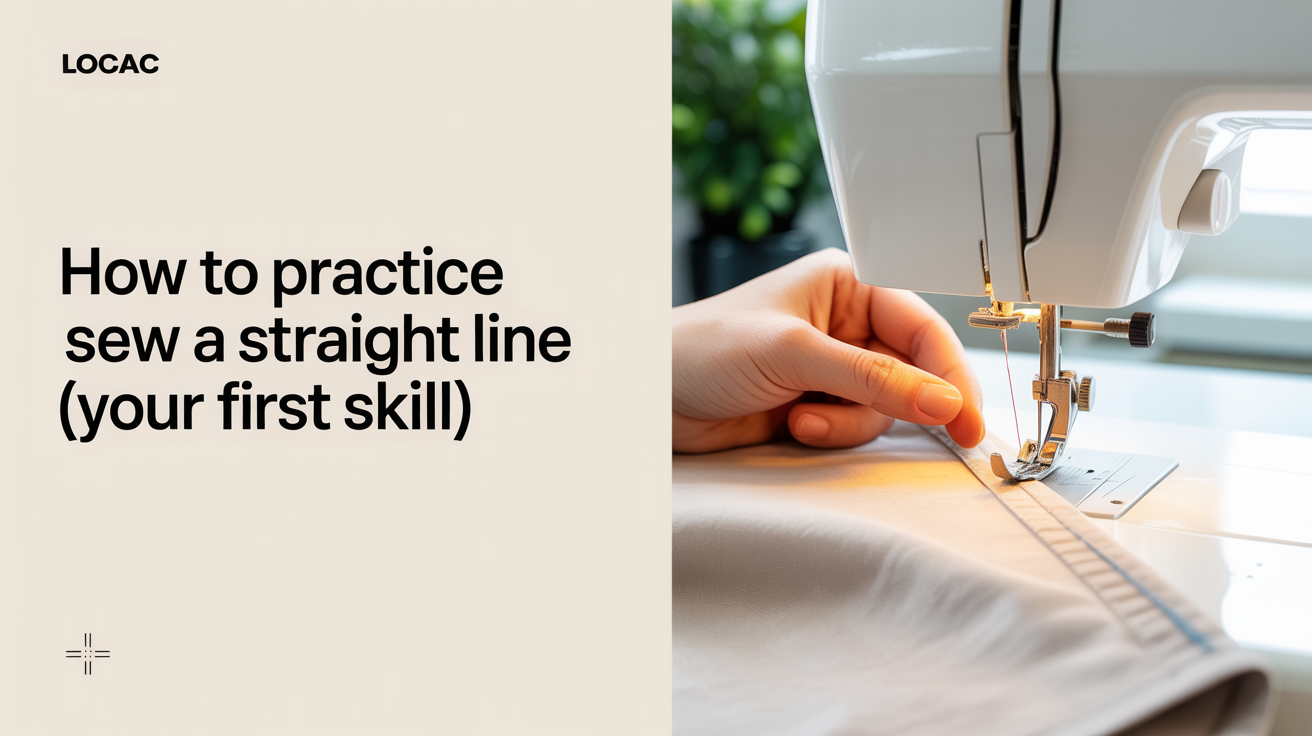
Sewing a straight line is the foundation of almost every project you will ever make. A well-aimed seam makes the difference between a finished piece that looks intentional and one that looks rushed. The good news: straight stitching is a learned skill, not a natural talent, and the right practice drills will get you there faster than you might expect.
Before you thread a single needle, know that sewing involves sharp needles, pins, and scissors, and your iron runs hot. Always test machine settings and seam guides on scrap fabric before committing to your actual project.
What "Straight" Actually Means at the Machine
When sewers talk about a straight line, they mean a seam that stays a consistent distance from the fabric edge for its entire length. That distance is the seam allowance, usually 5/8 inch (1.5 cm) on commercial patterns or 1/4 inch (6 mm) on quilting projects.
The stitch itself does not have to be perfectly mechanical. Small, gentle curves of a fraction of a millimeter happen to every sewist, and at normal viewing distance they are invisible. What ruins a seam is a gradual drift, a sudden jog, or an overcorrection that produces a zigzag path. Keeping a consistent seam allowance is the real goal.
Your machine has seam guide markings engraved or printed on the needle plate, the flat metal surface under the presser foot. Those numbers (usually in both inches and millimeters) measure from the needle to the edge of your fabric. Most beginners discover them late and then wonder why straight lines got so much easier.
Setting Up to Practice
Gather scrap fabric
Cut several strips of quilting cotton or muslin, roughly 3 by 12 inches. Woven fabric with a visible weave is ideal because you can use the grain lines as a visual reference. Avoid knits and slippery fabric until straight lines on woven cloth feel automatic.
Choose the right stitch length
For most woven fabrics, set your machine between 2.5 mm and 3 mm. Shorter stitches are harder to unpick if you drift; longer stitches are forgiving. Adjust tension to whatever your manual recommends as the starting point and test on scrap before moving to your practice strips.
Use a seam guide, not the needle
Beginners often watch the needle as it stitches, which causes them to steer toward it and drift. Instead, pick a specific guide mark on the needle plate, align your fabric edge with that mark, and watch the edge of the fabric as it feeds. Your peripheral vision handles the stitch placement while your eyes handle the steering.
If your machine's guide marks are faint, place a strip of masking tape on the needle plate at your chosen seam allowance. The tape edge becomes a bold, easy-to-follow guide.
Four Practice Drills That Build the Skill
These drills work best in order. Spend five to ten minutes on each before moving to the next.
Drill 1: Stitching without thread
Load a scrap strip and run it through the machine with no thread in the needle or bobbin. Your only job is to keep the fabric edge on the guide mark. Watching the perforated line you leave tells you exactly where you drifted, without wasting thread or creating seams you will need to unpick.
Drill 2: Stitching on lined paper
Print or draw parallel lines 1/4 inch apart on plain paper. Feed the paper through your machine (no fabric) and stitch along each line. Paper does not slip or stretch, which removes one variable. The stitched line on paper shows your accuracy clearly.
Drill 3: Stitching a fabric strip on the grain
Take a woven scrap and find the straight grain, the direction the threads run parallel to the selvage (finished edge). Stitch a seam parallel to the grain using a guide mark. Because the weave gives you a built-in grid, you can see immediately if your line is wandering across threads.
Drill 4: Starting and stopping accurately
Many beginners drift most at the beginning and end of a seam. Practice starting exactly at the fabric edge and stopping exactly at the far edge, reversing (backstitching) 3-4 stitches at each end to secure. Do this on short 3-inch strips until starts and stops feel controlled.
Common Reasons Seams Drift
| Problem | Likely cause | Fix |
|---|---|---|
| Seam curves toward the needle | Watching the needle instead of the guide | Shift eyes to the fabric edge |
| Seam drifts right or left gradually | Feeding fabric at an angle | Square up fabric before you start; use both hands to guide gently |
| Jog at the end | Rushing to finish | Slow down for the last inch; stop with needle down |
| Wide seam at one end, narrow at the other | Fabric not aligned with guide at the start | Reposition before lowering presser foot |
| Seam curves near pins | Pins placed perpendicular but not removed soon enough | Remove each pin just before the foot reaches it, never sew over pins |
How Fast Should You Sew?
Slower is more accurate, especially at first. Most sewing machines have a speed control lever or a built-in slow mode; use it. Your foot pedal also controls speed: a light touch keeps things manageable. There is no prize for finishing a seam in record time, and a misaligned seam takes longer to unpick and redo than it would have taken to sew slowly the first time.
As straight lines become automatic, your natural speed will increase on its own. Rushing is a habit that slows your overall progress.
From Practice Strips to Real Projects
Once your practice strips show a consistent seam allowance for the full length of the strip, you are ready to apply the skill to a project. Start with pieces that have long, straight seams, like a pillowcase or a simple tote bag. Curved seams and corners come later; they build on the straight-line foundation you are building now.
If you want a broader look at what skills come before and after this one, the complete beginner's roadmap maps out the learning path in sequence. For a checklist of what you need at your machine before your first practice session, see the beginner sewing kit guide. And if you are deciding whether to practice on a hand needle or jump straight to the machine, hand sewing vs. machine sewing walks through that choice.
Frequently Asked Questions
How long does it take to sew a straight line consistently? Most beginners see clear improvement after two or three focused practice sessions of 20 to 30 minutes each. Consistency across an entire long seam usually follows after a few more sessions. Progress depends on how carefully you watch feedback (the stitch line you leave) and adjust, not just on how many hours you log.
Can I practice on paper instead of fabric? Yes, and it is genuinely useful, especially Drill 2 above. Paper has no stretch or give, which makes it easier to steer. It does not replicate the way fabric feeds under a presser foot, so transition to fabric strips once your paper lines are accurate.
My seams look straight but curve when I press them open. What is happening? Pressing can reveal a gentle arc that was not obvious before. This usually means the fabric was fed slightly off-grain. Check that your fabric edges are cut straight (not torn on the bias) and that you align the cut edge, not the grain line you can see through the weave, with your guide mark.
Do I need a special presser foot to sew straight? No. The standard presser foot that came with your machine is fine for straight seams. A quarter-inch foot, common in quilting, makes it easy to maintain an exact 1/4-inch seam allowance, but it is optional. The needle plate guides are enough to get started.
What if my machine pulls the fabric to one side as it feeds? This is usually the feed dogs (the small teeth under the presser foot) being misaligned, or the presser foot pressure being set too high or too low for the fabric weight. Consult your machine manual to adjust presser foot pressure. If the problem persists, a machine service may be needed; feed dog issues are rarely something to troubleshoot without the manual in hand.